
According to a new analysis from President Trump’s Council of Economic Advisers, the case for opening 401(k)s to private market investments is getting stronger.
CEA: Private Markets Beat Public Market Benchmarks
The CEA measured private equity returns using the Public Market Equivalent, or PME – a metric that compares PE fund performance against what the same dollars would have earned in the S&P 500.
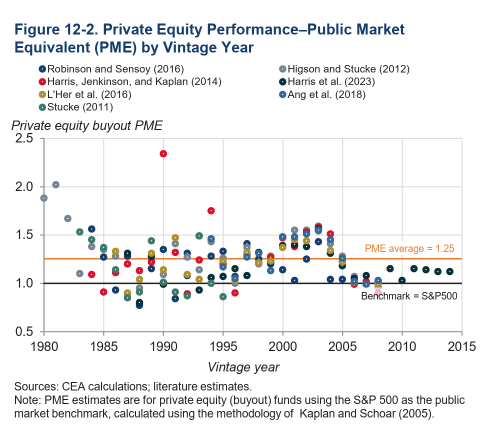
Across the vast majority of vintage years dating back to 1980, most PME estimates came in above 1.0, indicating consistent outperformance net of fees.
This is a four-decade track record of success.
CEA: Diversification Benefits Younger Workers in Particular
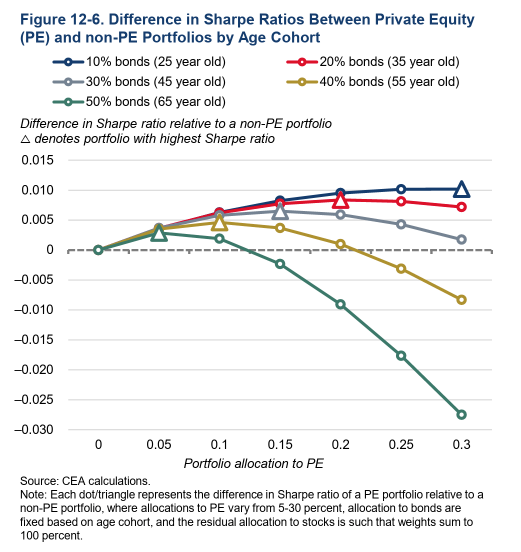
What often gets lost in the debate is that adding private equity to a portfolio is not simply a bet on one asset class outperforming another. Private equity does not move in lockstep with the public markets, which means it reduces the overall portfolio volatility in the same way as a traditional stock and bond mix.
Because of that, portfolios with private equity do not just earn more, but they earn more efficiently. The CEA measured this using the Sharpe ratio, which captures how much return a portfolio generates per unit of risk. Across every age group tested, adding private equity improved the Sharpe ratio. Younger workers saw the largest gains, but even workers near retirement came out ahead on a risk-adjusted basis.
This is how pension funds and institutional investors have been managing money for years. It is why they consistently allocate roughly 20 percent of their portfolios to private markets. The question was never whether private equity belongs in a retirement portfolio. The question was whether Washington would let ordinary Americans have the same access that institutions have always had.
The Rule Changes That
401(k) savers have not been kept out of private equity because it is too risky. They have been kept out because plan sponsors lacked the legal clarity to offer it without fear of litigation. The Department of Labor’s new proposed rule addresses that directly.
The Bottom Line
The White House’s own economists have now put the data on paper. Private equity has outperformed public markets across decades and vintage years. It diversifies a portfolio. It improves risk-adjusted returns at every age. And for years, regulatory barriers kept it out of reach for the Americans who needed it most.

Subscribe to Pinpoint Policy Institute