
The Point
America’s Housing Shortage is Driving The Home Affordability Crisis, Not Institutional Investors
Feb. 2, 2026
The rising issue of home affordability resulted in an Executive Order published last month from President Trump focused on “making sure that large institutional investors do not buy single-family homes that could otherwise be purchased by families.”
As Pinpoint has pointed out over the past year, a strong preponderance of data and analysis consistently show that large institutional investors actually represent a very small fraction of the single-family housing market, less than 1-2% nationally, and that their activity in the housing market isn’t the driver of rising prices or inventory shortages.
Economist Noah Smith broke it down in his piece last summer titled “Corporations aren’t the reason your rent is too high”:
“Almost zero of the U.S. housing stock gets bought by owners who own more than 9 units. Corporate landlords just aren’t significant enough to be driving the rental crisis in America’s most desirable cities. (Of course, this doesn’t stop anticorporate types from mocking the very idea that high rents are caused by something other than market power.)
“In fact, it gets even worse for the antitrust story here. It turns out that corporate landlords probably don’t even do what antitrust people think they do! The common story is that corporations buy up all the houses in an area, thus creating a local monopoly, and using that local monopoly to jack up rents — which in turn causes gentrification and pushes poor people and minorities out of the neighborhood.”
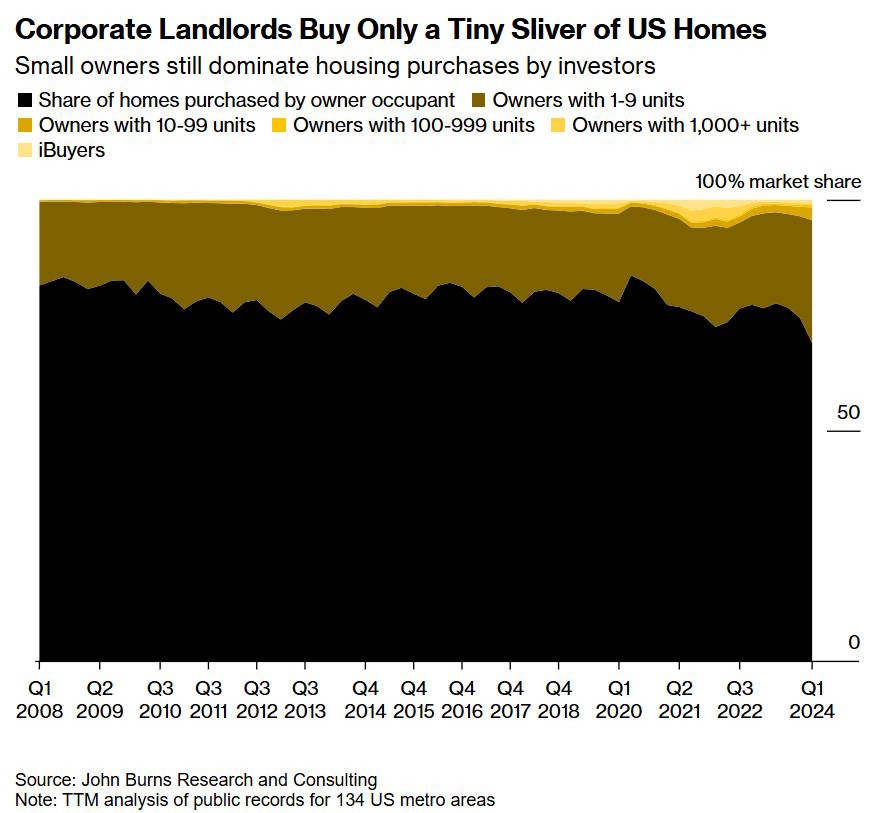
The Wall Street Journal editorial board confirmed the point earlier this year:
“Progressives have long blamed high housing prices on large investors that buy properties to rent and thereby supposedly squeeze out middle-class families. But this doesn’t fit the facts of the housing market. The top two dozen single-family rental firms own about 520,000 homes in the U.S. combined. That’s less than 1% of the single-family housing stock. …
“Institutional investors simply aren’t to blame for the more than 50% increase in housing prices since early 2020. The biggest culprit is inflation followed by the higher interest rates to contain it. Owners who locked in low mortgage rates are now reluctant to move, which means fewer homes for sale.
“The longstanding problems for housing supply are zoning regulations and permitting red tape that limit new construction.”
Pinpoint has repeatedly addressed these narratives. In 2024, we debunked the viral claims on social media asserting that “in 2023 private equity firms purchased 44 percent of all the single-family homes in America.” This has no basis in fact. We’ve highlighted examples from cities like Austin, Texas, where robust permitting and building cooled rent prices – with median rents dropping 22% from 2023 peaks after a surge in construction.
Activist organizations like the Private Equity Stakeholder Project have circulated claims that private equity firms own roughly one in ten apartments in the United States – but failed to publish the underlying data that would support their argument. Instead, they prescribe solutions that would restrict housing supply and therefore increase housing costs.
Proposals that target institutional buyers would be largely symbolic if enacted. Experts widely agree that to truly address housing affordability, the core challenge remains a supply-side problem. Excessive local regulation and barriers to new construction are the main drivers of cost and limited inventory. Addressing these root causes offers the most direct path to restoring affordability and expanding homeownership access for Americans.