
The Point
NC Poll: 65% Oppose Massive Cut to Biomedical Research, Cuts Might Cede American Science Edge to China
As the government funding deadline approaches at the end of September, debate has heated up in Congress about funding levels for the National Institutes of Health (NIH), the leading public funder of biomedical research in the world. A majority of Republicans in Congress are currently working to preserve funding to NIH, which the White House originally proposed cutting by some $20 billion. Meanwhile, the Senate’s bipartisan bill even includes a slight increase. To be clear, the proposal trims other areas, such as the CDC – but represents a bipartisan, bicameral consensus on the importance of biomedical research, and the need to preserve NIH’s role in advancing cures for diseases like cancer and Alzheimer’s.
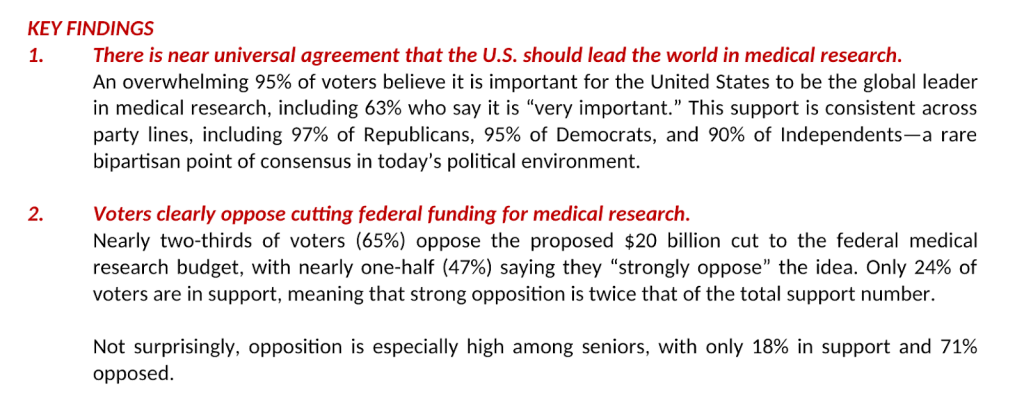
This debate comes as recent polling shows overwhelming support for scientific research funding in key swing states like North Carolina. As Axios reported, new polling from the GOP firm Public Opinion Strategies finds that 95% of voters believe US should be the global leader on medical research, 65% oppose large-scale federal cuts to medical research, and a majority are worried about impacts on cancer treatments. More than half (56%) said they’d think twice about voting for a member of Congress who supports these cuts, and that number jumps to 63% for moderates. North Carolina is a key state for the 2026 midterm elections next year, with one of the most closely-watched open seat races for U.S. Senate.
Not only are these proposed cuts unpopular – many experts in the space believe they risk America’s global leadership on science. Most notably, cuts of this scale threaten to cede the future of global scientific supremacy to our adversaries – most notably, to China:
Is the United States now trying to lose the technology race with China? It certainly seems to be.
The race is tight, and now the Trump administration is slashing funding for the three national institutions that have underpinned science and technology (S&T) and what advantage the US still has.
China is outpacing the US in the volume of high-impact research in 57 of the 64 critical technologies in ASPI’s Critical Technology Tracker. The US’s main remaining advantage is downstream in implementing technology, and even that’s at risk as China’s significant S&T investments pay off.
At the end of the day, a robust NIH isn’t just about health, it’s about keeping America out front of our adversaries on science globally. Lawmakers and the administration must prioritize science to ensure that the United States remains at the forefront of discovery.