
The Point
PESP’s Private Equity State Risk Index: Incomplete, Inconsistent and Arbitrary
Critiques of the financial services industry are nothing new – there is a robust tradition in U.S. politics that reliably paints business in general and financial institutions in particular as antagonists to everyday Americans. These claims are often reflexively invoked when progressive policies backfire. For example, spurious claims of “corporate greed” have been invoked of late to shift blame away from inflation that was catalyzed by excessive stimulus. Likewise, as housing supply has been constrained due to policy choices, some quarters have sought to pin the nation’s housing affordability challenge on “Wall Street,” despite clear evidence that such claims are wildly incorrect.
A recent initiative by the Private Equity Stakeholder Project (PESP) follows in the tradition. This past spring, the progressive group launched what it calls a “Private Equity State Risk Index,” which ranks states based on some 16 metrics that purport to characterize the footprint and risks associated with private equity investment across all 50 states This index has since been credulously cited by national news outlets and policymakers. Despite the veneer of credibility and rigor, a basic review of its underlying data demonstrates that it contains multiple methodological deficiencies that should give observers serious pause before relying on any of its conclusions.
Incomplete
The most obvious deficiency in the Index is that it is incomplete. The Index purports to measure states across four broad categories: labor, healthcare, housing, and pensions. Within these categories are a range of indicators that purport to capture the private equity industry’s role in those sectors. The Index assigns scores to these measures based on the degree to which those data reflect greater or lesser degrees of private equity’s involvement in each sector. States are then ranked based on their scores in each of the Index’s four main categories. The combined scores are then used to rank the states overall.
In reviewing the data, one can plainly see that data is missing for a number of states, across a number of categories.
The screenshot below captures several examples of these missing entries. According to the Index, the state of New Mexico is the most “at risk” from the private equity industry. It earns a 100/100 on the risk Index, and a 76/100 on the Index’s labor ranking, the 4th worst by that measure. But note that it does not have data for one metric that the Index relies upon – employee health outcomes – to formulate the labor score. This is true for other states’ labor ranking, such as Rhode Island, New Hampshire and Wyoming, which are similarly missing data to substantiate the rankings.

This flaw is also evident across other measures and for other states. For example, despite being ranked as the 3rd and 4th most “at risk” from private equity’s involvement in healthcare, there is substantial data missing for Rhode Island and Florida’s health care ratings, as is true for other states further down in the rankings.
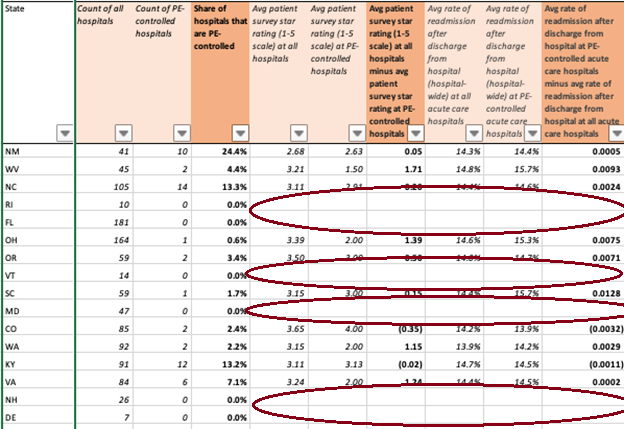
These data omissions may or may not alter the relative position of states in their rankings, but do invite skepticism as to the robustness of the Index.
Inconsistent
The data omissions noted above compound another deficiency in the Index, specifically inconsistency in the data sampled. Having incomplete datasets for a given state for a given measure makes direct comparison, and therefore ranking, basically impossible.
One of the rankings that is an input to the states’ labor scores is the share of layoffs at PE companies. However, the Index sums total layoffs, and ranks states based on the share of average state private sector employment over the period 2015-2022. This approach fails to scale the layoffs to the size of the state’s workforce. It can also introduce the possibility of other distortionary errors. For example, again looking at New Mexico, the average private-sector workforce over 2015-2022 averaged 645,900 workers. However, according to the WARN database, layoff data for New Mexico is only available going back to 2016. It is unclear if the 2015 data was sourced elsewhere, but it raises the possibility that the period covered by the numerator in the relevant ranking is inconsistent with that of the denominator.
There are other notable inconsistencies among the metrics used to rank states within the Index. One example is an inconsistent approach to sample periods. For example, for the labor category, the Index includes labor measures for periods covering 2015-2022 and 2018-2022 for certain metrics. These periods cover different periods of the business cycle, and it is unclear what animated the selection of inconsistent time periods.
Arbitrary
In general, the Index asserts measures of “risk” to exposure to private equity, but in general do not correlate those risks to actual economic outcomes. Perhaps the most egregious example relates to housing. Among the four categories assessed by the Index, states’ housing rankings are the most highly correlated to the overall score. To measure the “risk” of private equity to states’ housing sectors, the Index measures home purchases by medium, large, and the largest housing investors. As noted above however, this is a highly misleading and inaccurate proxy for institutional investment in housing generally, and private equity specifically. It is noteworthy that the period covered by the housing “risk” ranking includes the substantial churn in the housing market during the pandemic. To be sure, as demand in some markets, such as the Sunbelt, increased during the pandemic, investment flowed to those markets. However, the data are clear that this investment is largely driven by investors other than large institutions such as private equity. Importantly the “risks” to the housing market asserted by the Index are in no way reflective of housing affordability. Indeed, the Index rates the New York and New Jersey housing markets as the third and fourth least risky, despite being among the top ten least affordable housing markets.
Further, the labor measures do not measure labor outcomes in the broader economy to contextualize the findings. Likewise, many of the health metrics do not measure health outcomes. For example, Alaska and North Dakota received perfect (0/100) scores for health risks. This was largely due to the fact that most of the relevant data for the Index’s health category was not available. Nevertheless, it is noteworthy that this Index gives these states the most benign health-related score, when rankings of the those states actual health systems suggest they are in the bottom half of U.S. states in terms of performance. Similarly, the pension risk measures have no relationship to pension funding. 5 of the 10 “least risky” pensions (Alabama, Connecticut, South Carolina, New Jersey, and Kentucky) according to the Index are among the 10 state pension funds with the lowest funding ratios.
Conclusion
“Garbage in, garbage out.” Given the multiple data and methodological problems identified above, this old saying is well applied to PESP’s new State Risk Index.
Progressive groups like this enter the debate with the pre-set perspective that “Wall Street” and major financial institutions are inherently negative influences on society. As such, they obviously come to the conclusions they do in this supposedly “rigorous” study, hoping no one actually clicks through to review the underlying data and methodology.
That’s where Pinpoint comes in. Our analysis of this study reveals its obvious flaws, and it is our mission to enable public policy decisions to be made that benefit all Americans by providing factual information.