The Point
Tax Foundation Brings the Carried Interest Debate Back to Reality: Minimal Revenue, Slower Growth, and Thousands of Lost Jobs
A new analysis from the nonpartisan Tax Foundation provides new data estimating the negative economic impact of raising taxes on carried interest – an important contribution to the debate after the Yale Budget Lab – recently in the news for its partisan activities – released a headline-grabbing (and dubious) estimate that it could raise $100 billion in new federal revenues.
Highlights:
- Tax Foundation finds carried interest tax hike would raise just $6.1 billion over 10 years (after economic effects) — a fraction of Yale Budget Lab’s dubious $100 billion headline estimate
- The policy would destroy 9,000 jobs and shrink GDP, capital stock, and wages — making America less competitive and suppressing the investment capital that drives economic growth
- Yale’s $100 billion figure relies on novel methodology and aspirational assumptions, including attributing 100% of Section 1231 gains to carried interest — a maximum-case scenario designed to generate talking points, not honest accounting
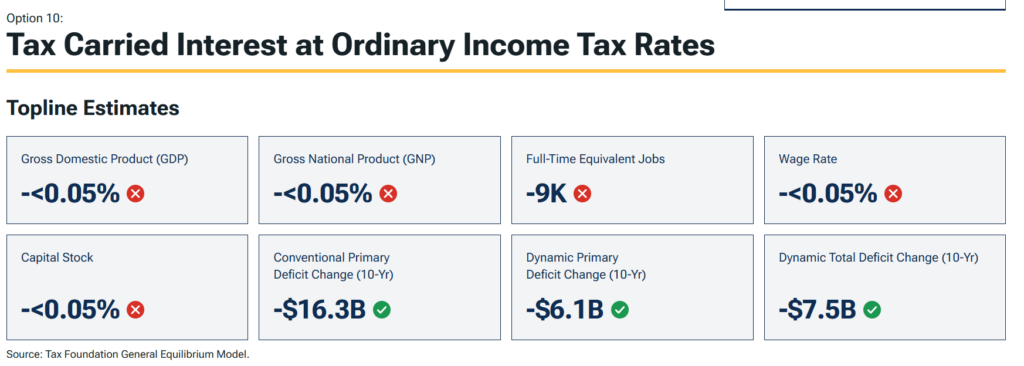
In its new Tax Reform Options guide, the Tax Foundation ran proposals to raise taxes on carried interest income through its rigorous General Equilibrium Model, and the results are damning for proponents of the policy who claim this tax hike would raise significant revenue. It found that taxing carried interest at ordinary income rates would reduce federal revenues by just $16.3 billion over ten years – and only $6.1 billion once real-world economic behavior is accounted for. That’s a small fraction of Yale’s $100 billion estimate.
Moreover, it found that raising the tax would result in a loss of 9,000 full-time jobs, along with reductions in GDP, GNP, capital stock, and wage rates:
Enter Yale Budget Lab
Pinpoint has previously highlighted the Yale Budget Lab’s ideological bias towards progressive policy positions, despite claiming to be a “nonpartisan policy research center.” So it’s little surprise that their May 2026 report on carried interest claims of $100 billion in new federal tax revenues over ten years wildly diverges from the Tax Foundation’s robust model.
The Yale Budget Lab reached their calculation (which has been cited by the New York Times, Axios, and liberal non-profit Americans for Financial Reform, among others) by building an estimate on top of a single 2025 academic paper using novel assumptions about partnership structures, while acknowledging that carried interest does not appear on any specific tax form, requiring estimators to “infer” the tax base through proxies and modeling assumptions. In Yale’s most aggressive scenario, their $100 billion headline requires attributing 100% of Section 1231 gains – gains from the sale of business property, not fund performance fees – to carried interest. Using the most aggressive scenario is meant to generate headlines and talking points.
Why It Keeps Failing
Progressives have long pushed proposals to tax carried interest as ordinary income – introduced in virtually every Congress since 2007. Republicans and many Democrats have consistently rejected tax increases on carried interest, including most recently in the One Big Beautiful Bill.
The Tax Foundation’s analysis provides a clear reason why: a permanent tax on investment activity makes America less competitive, destroys jobs, and suppresses the capital that funds economic growth.
Yale’s $100 billion headline is built on novel methodology and aspirational assumptions. Congress has been right to repeatedly reject this tax hike. The Tax Foundation’s model gives policymakers and the public the honest accounting they deserve.
More from Pinpoint:
- Sen. Roger Marshall: “The Yale Budget Lab is just another Democrat think tank full of economists that consistently get it wrong”
- ICYMI: Yale’s ‘Nonpartisan’ Budget Lab Was Founded By Biden Officials—and Its Staff Has Given More Than $100K to Dems
- ICYMI: Conservatives Slam Yale Budget Lab for “Falsely Claiming to be Nonpartisan”
- Partisan by Design: Yale Budget Lab is an Obama-Biden Policy Machine Run by Liberal Staff