
The Point
Testimony to Texas House of Representatives, Committee on Business and Industry
Chairman Longoria, Vice Chairman Vasut, and members of the Committee, thank you for the opportunity to appear today. My name is Gordon Gray and I serve as Executive Director of the Pinpoint Policy Institute, a nonpartisan, nonprofit educational organization dedicated to promoting and defending the essential pillars of American prosperity. Today’s hearing focuses on a matter of national importance, and one of particular concern to Texas – affordable housing. The purpose of today’s hearing is to evaluate the impact on housing markets caused by institutional investment in housing, and to consider potential policy responses. In my testimony today, I wish to convey 3 main points:
- The focus on institutional investment as a contributor to housing affordability challenges is misplaced;
- Research has found that institutional investment is not crowding-out other homebuyers; and
- Research has found institutional investment in the single-family rental markets can lead to improved social mobility and improved outcomes for families.
I will address each of these points in turn.
The Scope of Institutional Investment in Housing
To gauge the role of institutional investment in home prices, it is important to scope the magnitude of institutional investment in housing markets and related rental markets. There has been considerable scrutiny of investment in housing as home prices have risen throughout the pandemic and after. However, the footprint of institutional investment in this space has been subject to significant misrepresentation. Perhaps most emblematic of this misperception is a viral claim on social media that asserted “in 2023 private equity firms purchased 44 percent of all the single-family homes in America.”[1] This claim has no basis in fact.
The genesis of this misleading stat can be traced to a November 2022 Business Insider story noting that in Q3 of 2022, investors bought 44 percent of flipped homes according to data from a housing market research firm.[2] Note that this observation relates to house-flipping, not overall purchases. It also reflects activity in one quarter of 2022. More importantly, it does not claim that large investors such as private equity or other institutional investors purchased these homes, but rather “investors” overall. Yet this statistic about a small slice of the housing market has since been distorted into the broad claim that private equity bought nearly half of all homes sold in 2023.
Unfortunately, this is precisely the sort of statistic that can capture public attention, and correcting the record is an exercise of catch-up. The notion that institutional investment is driving housing affordability has been the subject of Congressional hearings and continuous media coverage. One must look beyond the headlines to get a real look at the facts, which will show that institutional investors are a scant fraction of home buyers. Institutional ownership of single-family rental homes stood at 3.8 percent in 2022 nationwide, according to the Urban Institute.[3] According to John Burns Research and Consulting, large institutional investors have virtually abandoned the housing market in recent quarters.[4] And even prior to that, large investors (i.e., those owning more than 1,000 homes) never purchased more than 2 percent of homes in a given quarter.
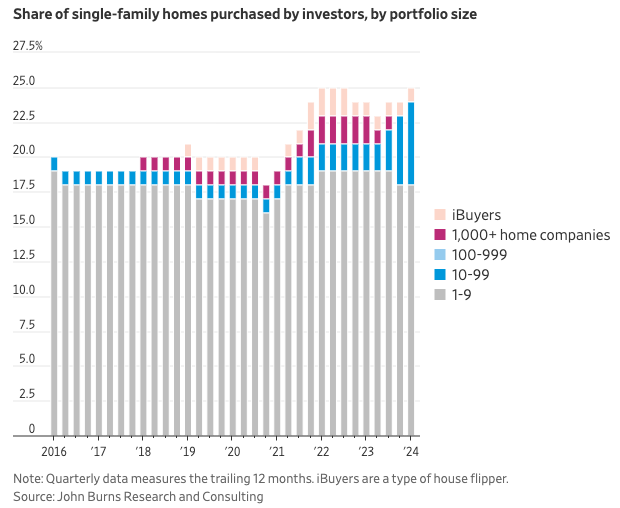
To be sure, market participants have been keen to invest in areas that have seen significant growth over the pandemic, particularly in the Sunbelt. Even so, small- and medium-sized investors have been responsible for the vast majority of these investments. This majority group would include average Texas families renovating and rehabbing homes for investment purposes. For example, Texas was a leading market for home investors in 2023, with investor purchases comprising 31 percent of home sales in the state.[5] However, large investors (i.e., those owning 1,000+ homes) were only responsible for just 4.2 percent of single-family home purchases the year prior. This share of large institutional purchases is consistent with other public data.[6] In sum, the data simply does not support the idea that institutional investment is contributing meaningfully to housing affordability challenges, and this is borne out in other research.
Market Effects from Investment
Given that institutional investment has a relatively modest footprint in the housing and rental markets, it should not have outsized effects on price discovery within those markets. One study by economists from the University of Southern California, Arizona State University, and the Federal Reserve Bank of Philadelphia examined institutional investment as it related to numerous housing market outcomes. Their findings contradict the popular narrative regarding institutional investment in housing.[7]
To assess these outcomes, the authors constructed a novel dataset to track the properties held by Single-Family REITs from 2010 to 2022. This dataset focuses on 16 U.S. states where nearly all such property holdings are concentrated, using public records from CoreLogic Tax assessment data. The dataset includes ZIP code-level data on REIT ownership and its changes between 2010 and 2022, capturing both the expansion of these investments and their concentration in specific geographic areas. The study found that the presence of this investment was correlated with increased housing supply. Notably, the authors found no evidence that institutional investment was crowding out other homebuyers. Specifically, the authors examined sale-to-list price ratios in relevant housing markets. As the study notes, if institutional investors were exerting price pressure, sellers should command higher prices relative to their listing prices. The authors found no such evidence, and indeed found slight negative correlation between the presence of institutional investment and sale-to-list ratios.
There is additional relevant research examining market outcomes in the presence of institutional investment. A study by economists at the Philadelphia Federal Reserve examined housing markets in the wake of the great recession.[8] The study found that investors played a pivotal role in stabilizing housing markets after the financial crisis. By purchasing distressed properties, investors helped support home prices in struggling areas, preventing steeper declines. The study highlighted that investors, particularly institutional investors, were able to buy properties in bulk and make improvements at scale, which contributed to price stabilization and neighborhood recovery. Thus, while institutional investment does not lead to crowding out of purchasers, it can serve as an effective floor for home values during periods of significant housing market deterioration.
Benefits of Investment in Single-Family Rentals
Beyond the scale and effect on markets from institutional housing investment, is its impact on market participants. There is a robust literature that these investments improve neighborhoods and social mobility, including educational outcomes. Research consistently shows that SFRs contribute to neighborhood stability, offer improved housing options, and create pathways for low- and middle-income families to access better living conditions.
As demonstrated in Lambie-Hanson et al (2022), real estate investment has material positive effects on housing stock quality. By purchasing foreclosed or distressed properties, investors were able to invest in rehabilitating homes that otherwise might have remained vacant or dilapidated. This not only stabilized prices as previously discussed, but also led to safer, better-maintained neighborhoods.
A key dynamic of institutional investment in housing markets is conversion of owner-occupied homes to single-family rentals. This feature can provide access to neighborhoods that were otherwise unbridgeable due to the wealth gap between prospective owners and prospective renters. In short, access to single-family rental can provide significant opportunity and social mobility for families priced out of homeownership.
In a 2024 study, researchers from the University of North Carolina and Virginia Tech examined the relationship between access to SFRs and access to higher quality schools for economically disadvantaged children.[9] The study found that expansion of the SFR market provides a pathway for low-income families to access high-performing public schools. By increasing the availability of rental housing in neighborhoods with better schools, families who previously could not afford to purchase homes in those areas now have more opportunities to rent and gain access to these schools. The benefits of these children moving to better schools was directly measurable, as findings in a related study demonstrate. The authors found clear evidence of improved educational outcomes, including that scholastic achievement improved for students that moved to better schools due to rental housing opportunities.[10] Notably, the study found that these improved scholastic achievements were broad-based by race and income. They likewise found that incumbent students’ performance did not fall with the introduction of these new students.
Among the most important contributions to the literature on social mobility have been made by Professor Raj Chetty of Harvard University on the significant link between housing, neighborhood choice, and social mobility. Chetty’s work on social capital demonstrates that the neighborhoods where children grow up profoundly shape their chances of upward economic mobility.
In a foundational 2014 study in the Quarterly Journal of Economics, Chetty and coauthors examined intergenerational economic mobility.[11] The study evaluates how children’s income relates to their parents’ income across different regions. The authors use anonymized tax data from over 40 million individuals to study mobility patterns. The study found that intergenerational mobility can vary significantly by region in both absolute and relative terms. Areas with higher mobility tend to have lower levels of residential segregation, less income inequality, better quality primary schools, higher levels of social capital (such as stronger social networks), and greater family stability. By moving to single-family rentals in these high-opportunity neighborhoods, lower-income families can help break the cycle of poverty for their children. These findings were further affirmed in follow-on research, also in the QJE, in 2018.[12] A more recent study also examined mechanisms for improving low-income families’ ability to search for housing in higher-opportunity neighborhoods.[13]
In a significant paper in Nature, Chetty and coauthors further articulate a framework for how social capital – the connections and networks families form in their communities – plays a crucial role in upward mobility.[14] The study identifies “Economic Connectedness,” the degree to which people from low socioeconomic status form friendships with people from high SES backgrounds, is the strongest predictor of upward economic mobility compared to other forms of social capital. The ability of families to move to neighborhoods through single-family rental market that would otherwise be inaccessible is a channel for this mobility.
Conclusion
While housing affordability is a significant challenge in certain markets, the facts and data clearly show that that the role of institutional investment in those markets is significantly misunderstood. Despite the rhetoric, institutional investment in housing is a fraction of overall investment in housing, and in the housing market overall. Consistent with this scale, institutional investment does not distort housing markets, and research has shown that this investment is not otherwise crowding about eligible homebuyers. Rather, where institutional investment is present, it can provide meaningful opportunities for improving families’ circumstances. By providing a pathway to higher-opportunity communities, institutional investment in housing can contribute to improved economic outcomes for families. These improved outcomes are measurable, with better schools, safer environments, and higher-quality housing, which, in turn, fosters greater social mobility. These opportunities should be encouraged, and I would urge the committee to consider policies that further expand housing supply and access for families.
A pdf of the testimony is available here
[1] https://twitter.com/WallStreetApes/status/1768633515451797864
[2] https://www.businessinsider.com/big-investors-purchasing-more-single-family-homes-from-home-flippers-2022-11
[3] https://www.urban.org/sites/default/files/2023-04/A%20Profile%20of%20Institutional%20Investor%E2%80%93Owned%20Single-Family%20Rental%20Properties_0.pdf
[4] https://www.wsj.com/real-estate/wall-street-has-spent-billions-buying-homes-a-crackdown-is-looming-f85ae5f6
[5] https://www.corelogic.com/intelligence/us-home-investor-share-reached-new-high-q4-2023/
[6] https://www.corelogic.com/intelligence/us-home-investor-activity-steadily-increased-third-quarter/
[7] Giacoletti, Marco and Heimer, Rawley and Li, Wenli and Yu, Edison G., Single-Family REITs and Local Housing Markets (August 14, 2024). Available at SSRN: https://ssrn.com/abstract=4895275 or http://dx.doi.org/10.2139/ssrn.4895275
[8] Lambie-Hanson, L., Li, W., Slonkosky, M., 2022. Real estate investors and the u.s. housing recovery. Real Estate Economics 50, 1425–1461.
[9] Mayock, Tom and Vosters, Kelly, Single-Family Rentals as a Pathway for Access to High-Performing Public Schools. Available at SSRN: https://ssrn.com/abstract=4882584 or http://dx.doi.org/10.2139/ssrn.4882584
[10] Mayock, Tom and Vosters, Kelly, Educational Achievement Gains Afforded by Moving to Single-Family Rentals (May 11, 2024). Available at SSRN: https://ssrn.com/abstract=4831525 or http://dx.doi.org/10.2139/ssrn.4831525
[11] Raj Chetty & Nathaniel Hendren & Patrick Kline & Emmanuel Saez, 2014. “Where is the land of Opportunity? The Geography of Intergenerational Mobility in the United States,” The Quarterly Journal of Economics, President and Fellows of Harvard College, vol. 129(4), pages 1553-1623.
[12] Chetty, Raj, and Nathaniel Hendren. 2018. “The Impacts of Neighborhoods on Intergenerational Mobility I: Childhood Exposure Effects.” Quarterly Journal of Economics 113 (3).
[13] Peter Bergman & Raj Chetty & Stefanie DeLuca & Nathaniel Hendren & Lawrence F. Katz & Christopher Palmer, 2024. “Creating Moves to Opportunity: Experimental Evidence on Barriers to Neighborhood Choice,” American Economic Review, American Economic Association, vol. 114(5), pages 1281-1337, May.
[14] Chetty, R., Jackson, M.O., Kuchler, T. et al. Social capital I: measurement and associations with economic mobility. Nature 608, 108–121 (2022). https://doi.org/10.1038/s41586-022-04996-4