The Point
WATCH: Labor Dept. Deputy Secretary Sonderling at SIFMA Private Markets Roundtable on 401(k) Executive Order
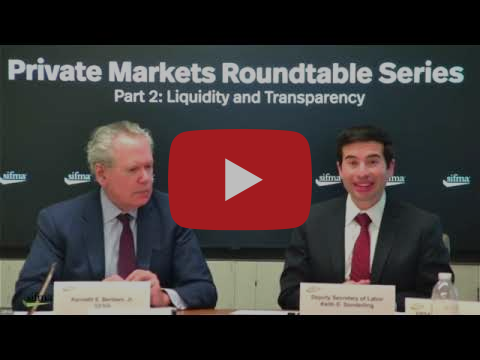
On Wednesday, U.S. Department of Labor Deputy Secretary Keith Sonderling spoke on the implementation of President Trump’s Democratizing Access To Alternative Assets for 401(k) Investors Executive Order at the SIFMA Private Markets Roundtable Series.
Watch (and read) below the Deputy Secretary’s comments, where he states that “our first and foremost priority is ensuring that the President’s executive order on alternative assets occurs, happens and is done in a way that is going to last for a long time.”
Transcript from SIFMA Event Wednesday, January 7, 2026:
SIFMA President & CEO Kenneth E. Bentsen Jr.:
Right, right. So maybe digging down and the Deputy Secretary, you got us in the opening part of your remarks talking about the role of the department and the administration and really wanting to drive increased benefits from retirement and retirement assets for American workers and retirees. Maybe give us a little more overview of what are your priorities and then I guess essentially priorities in the retirement space for the department?
Deputy Secretary Keith E. Sonderling:
Yeah. I mean, our first and foremost priority is ensuring that the President’s executive order on alternative assets occurs, happens and is done in a way that is going to last for a long time. And as the President wants and has stated in his executive order to open up the private markets to the 401(k) world, and that is on the Department of Labor under ERISA to do that.
And we see significant benefits in this and the ability to really reform the retirement industry broadly under longstanding ERISA principles. And I think what’s so exciting about this executive order is that it really gives the Department of Labor the license not to create anything new, to go back to the basics of ERISA and look broadly of all various types of possible investments allowed in 401(k)s and just be neutral and say, “Here’s what the principles are. Here is what we are going to look at when plan sponsors are making those determinations about, above my head, liquidity and transparency, about fees, all of that.”
But I think what we need just to take a step back when it comes in all to this, none of this is novel. All of this is going to be based on longstanding principles that plan sponsors have for new words for me like prudence related to how they’re going to do that. But they’re not going to do that without people from the Department of Labor, which I publicly announced that we will be doing and a rule that could last.
And that’s what’s so important and that’s why our number one focus right now at EBSA with all of everything we have to do, and we do a lot in the healthcare space, PBM reform, as a lot of you know, is to ensuring that plan sponsors, that the entire regulated communities understands what analysis has to be done when looking at any asset into a 401(k). Whether it’s public, whether it’s private, alternative, whatever you want to call it, we need to give those baseline principles.
And it’s very complicated because of the state of the industry. And that’s where I was talking about earlier, is that when you have an industry that is really living in fear based on every decision that they have to make, because a lawyer or a judge is going to potentially second guess that, we have to eliminate that. And through the President’s executive order, it allows us to do that on each of these various topics that have caused plan sponsors to not want to make investments, whether public, private, or an investment we don’t even know about yet.
And we feel like we can solve that through this executive order. But the only way to do that is to work together because from our perspective at the Department of Labor, we understand ERISA, we understand what the rules of the road are going to be, and we’re going to really hammer that and make it as clear as possible.
But all of you in this room know the practical impacts that’s going to happen. You know how these products need to be built to satisfy not only ERISA, but ultimately the plan sponsors and this whole community that’s going to be responsible for purchasing and implementing it and ultimately proving to their employees that this is in their best interest, that this is going to be the way to create wealth in retirement through your 401(k). And that’s what we really want to do.
We want to remain neutral. We want to double down on the ERISA principles for all of these, but actually answer those questions and not just be general, as I’ve been talking about now, getting very specific into each category that gives plan sponsors heartburn, that gives them pause, that they automatically say no because of the fears when the answer may be easily yes based upon laws from the 1970s.
So that’s what we’re really focused on in a broad context, but I understand it’s extremely complicated. And I know each of these categories, whether it’s liquidity, transparency, disclosures, et cetera, require a new lens in 2026 when you’re asking plan sponsors ’cause of the President’s executive order to help to diversify. And that’s why I’m here today. That’s why we’ve been working together, and that’s where I need and the department needs help from all of you as experts knowing where those bounds are and knowing what that guidance needs to be to be able to make this work.
Bentsen:
So maybe as a follow-up to that, and I’m going to come back to the litigation and the issue, ’cause that’s very important that you raised, but today we’re doing this session on liquidity and transparency. We did one on valuation earlier, well, last year now. You kind of touched on this, and then we’ve talked about this before. What more could the industry, could the public, other commentators, as you go forward with the rulemaking, what more is the department looking for? What could be helpful to the department in terms of filling the file, if you will, the comment file, helping the department, as you were noting just a second ago, in developing a rule that can stand the test of time?
Deputy Secretary Sonderling:
The most important part is all of your participation when the rule does come out in the public comment period. This is your chance to tell us what we got right in our analysis, what we got wrong, what will work practically from a business perspective, what may work. Obviously, nobody gets everything they want, and our job is just to review all the comments and respond to all the comments. So even if they’re critical of what we’re trying to do, whether it’s from industry advocates or people who don’t think this is the best idea, we have to address those.
So for each of these various topics, all that data and information is out there. I think the difference now between the public markets and the private markets is in their own world, public, whether it’s liquidity, whether it’s the valuation, it’s public. And in the private markets who now want to and have been willing to enter into this world for some time now and already do exist in this world, of course, in certain pension markets, need to tell us exactly differences between the public, the way we look at the public liquid, whether it’s transparency, liquidity, versus in private where it’s not readily available.
And how do you now discern that into a level that will meet our requirements ultimately for the plan sponsors and the American worker that is allowed to see that, needs to see that under the law. And of course, having it being their money, some of these liquidity issues that are just different. And you’re the experts and you all know.
And as these products are being built and as these products are being marketed, we need to know all that information and we need to understand how you’re going to address these concerns that the executive order broadly discusses, but they’re so individual to different asset class. And I understand that private credit, liquidity, valuation, whatever the transparency topic is going to be different than private equity that might be different than real estate investments that may be different than cryptocurrency, whatever the broad definition of an alternative asset is.
So I think for each of those products that you’re considering offering to plan sponsors and for the plan sponsors themselves, here’s the questions that we are going to ask those who are selling us these products. For those developing these products, here’s the questions we are struggling with as we build a product that’s trying to be ERISA compliant. And all that I understand is very proprietary, it’s very private, but to enter in this world.
And when you’re dealing with individual’s 401(k)s, which is they’re relying on to live in retirement from all their hard work, that’s over. That needs to be transparent. It needs to be there. Ultimately, the American worker needs to understand at a very basic level that this money, if they need it, of course, in the context of all the 401(k) existing restrictions will be available, is properly being invested through the much more complicated analysis for the plan sponsors too.
So addressing all of those. And then that also plays into addressing the ultimate litigation risks, which is completely frozen in the private markets. And knowing where some of these lawsuits have been, knowing what some of the creative ideas might be for new lawsuits moving forward, as we’ve seen publicly, just based upon the executive orders. I read all the papers and the trade publications too, and there’s already threats about what we may or may not be doing.
That all needs to be addressed on the front end. And that’s why we’re going … I want to say we’re going slow because there’s no slowness in the Trump administration. We’re moving. But we want to do it the right way. And that’s why we’ve been having … We’ve had an open door policy. We’ve met with many of you in this room. And we want to have that because we want to do it right.
Because ultimately we want to be able to step back and let you all do your jobs, with the plan sponsors do their jobs saying, “Here’s the parameters, here’s where the safe harbors are, here’s where examples are, here’s what’s going to work, here’s where we’re going to potentially cross the line,” whether it’s on fees, whether it’s on disclosures, there’s just so many different topics and so many different ways to go. That’s our ultimate goal, to have a rule that the plan sponsors understand and those building and projects can understand, building them in this framework so we can work and Americans can become wealthier.
Bentsen:
So maybe in the few minutes we have left, you mentioned a couple of things, litigation, fear, plan sponsors issues, the amicus program and as I noted the industry really welcomed it. And we don’t represent the plan sponsors, but we engage with them a lot and we consider them partners. But the amicus, the brief that you all filed, very important. Obviously, as you pointed, carries the weight of the government.
Two questions here. One is, are there other areas of litigation involving plan sponsors where the department is involved or you think you’re going to get involved? And then beyond that, which may be perhaps somewhat beyond the remit, maybe within the remit of the labor department, maybe beyond, maybe up to Congress, what are you all thinking in terms of litigation reform with respect to plan sponsors?
Sonderling:
Well, litigation, that is outside of our … I’ll take the answer saying you can have your conversations with Congress on that. But it goes back to the same point I’ve been making. There is a litigation reform at the Department of Labor and all the federal agencies by addressing those issues and understanding where there are … If there’s litigation, something is wrong, something’s being accused wrong, or it’s a lack of clarity in the guidance.
And that’s what really what we’re doing throughout all of our enforcement agencies at the Department of Labor. And I don’t mean to be sound repetitive, but this is … You all know this. You’ve tracked this every day, you’re living it, you’re defending it, and that’s where we want to get involved is to slow down that litigation based upon … I’ve seen it at Department of Labor across the board based on a paragraph and an enforcement handbook from the 1960s. Suddenly there’s a wave of litigation in 2022 about that.
And how do we keep up with modern times by continually update all of our regulatory and sub-regulatory guidance? And that’s where I’m excited to be able to hear from you, work together, continue our open door policy and not ever surprise anyone on this room or in this call, whether you’re representing plaintiffs or defendants in any of these cases from the Department of Labor making a policy in the dark and not being transparent about it.
And that’s why going back to the executive order, we’re doing this in the most historic, transparent way we could ever possibly be doing by having these discussions in advance, by committing to doing rulemaking where everyone can have their comments in. That’s your chance. If you miss that window, it’s over.
And that’s the approach I want to have when it comes to this because that’s how we’re going to be able to ultimately provide the best options for the American retiree.