News
ICYMI: Pensions & Investments: Commentary: It is time to bring private markets into America’s 401(k)s
A new Pensions & Investments commentary makes an empirical case for the DOL’s proposed private-markets safe harbor, modeling a $536,000 retirement savings boost for a middle-class worker who gains access to alternative investments through their 401(k). The authors argue the question is no longer whether private markets belong in retirement portfolios, but how to bring them in carefully and at scale.
“The results are stark. Assuming $1,000 in monthly employee contributions, a 25-year-old starting their career today would accumulate a median projected retirement balance of $2.80 million with the 30% private-market allocation, compared to $2.26 million in the traditional public index portfolio. That is a $536,387 increase, representing a 23.7% expansion in total career growth.” – Jasmin Sethi and Scott Brooks, Pensions & Investments
Commentary: It is time to bring private markets into America’s 401(k)s
By Jasmin Sethi and Scott Brooks
Pensions & Investments
August 6, 2026
The DOL’s proposed safe-harbor for private assets in DC plans is an opportunity to bring useful exposure into DC plans carefully, professionally and at scale. The question is no longer whether private markets belong in retirement portfolios; our analysis demonstrates that the case for including them is compelling — simply based on the numbers.
Used prudently within professionally managed, diversified vehicles, private-market exposure can be one tool for helping address the retirement savings gap facing many American workers.
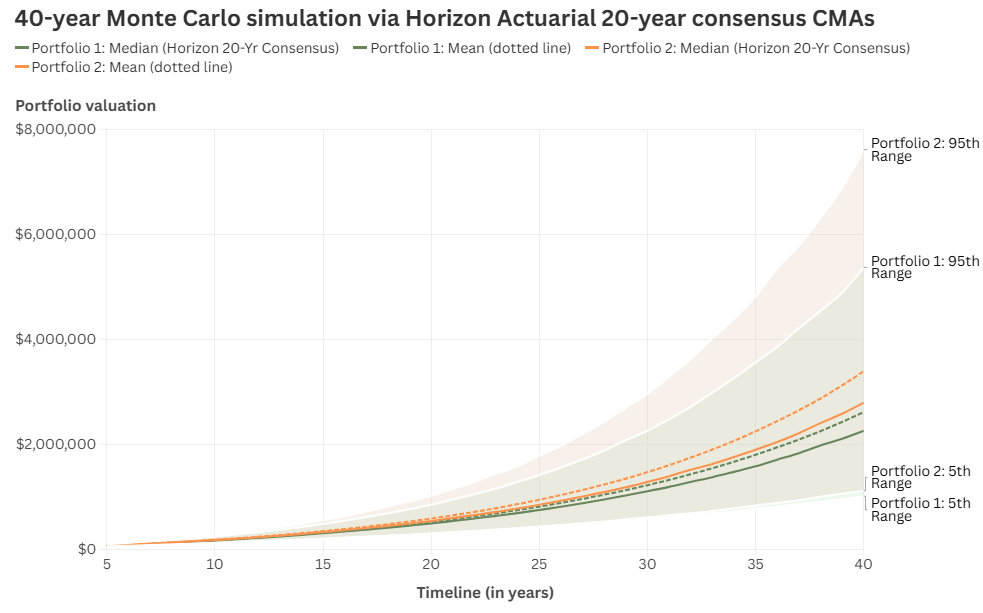
Using the 20-year actuarial capital market assumptions of the 2025 Horizon Actuarial Services Survey, which aggregates data from 41 major investment firms, we have modeled a correlated 10,000-trial Monte Carlo simulation where a 25-year-old makes $1,000 monthly contributions over 40 years in two portfolios. Put more simply, we ran 10,000 possible market scenarios to compare how the same saver might fare over a full working career depending on whether their retirement account included private-market investments or stayed entirely in traditional public markets.
Portfolio 1 is a traditional core 60/40 public index portfolio, meaning that we assume that 60% is in equities consisting of 40% large cap, 10% small/mid cap, and 10% international. Forty-percent debt consists of 10% Treasury and 30% corporate bonds.
Portfolio 2 is a core index portfolio that reallocates 30% into private markets, split evenly across private equity, real estate, and private debt (10% each). The remaining 70% is split 30% for large-cap equities, 10% for small/mid-cap equities, 10% international equities, 10% U.S. Treasury, and 10% corporate bonds. We use index returns net of investment fees to simulate the returns of these portfolios.
The results are stark. Assuming $1,000 in monthly employee contributions, a 25-year-old starting their career today would accumulate a median projected retirement balance of $2.80 million with the 30% private-market allocation, compared to $2.26 million in the traditional public index portfolio. That is a $536,387 increase, representing a 23.7% expansion in total career growth. Any difference could be magnified by a growth in contributions and an employer match, usually up to 3%-5%.
The retirement challenge is becoming more severe. Americans are living longer, health and long-term-care costs continue to rise, and many households are already under-saved. Many capital-market forecasts suggest that traditional public market portfolios may not deliver the returns needed to close the gap. The answer cannot simply be to tell workers to save more. Middle-class households have limited room in their budgets. Higher long-term returns, achieved prudently and with diversification, must also be part of the solution. Private markets are complex, less liquid, harder to value and often more expensive than public-market investments. Those realities require thoughtful guardrails rather than outright exclusion.
The great myth that is being portrayed in recent comments to the DOL on the proposed regulations is that private market investments will be generally offered directly to DC plan participants. The practical path will not be self-directed private equity menus for individual workers. Private assets will be accessed through professionally managed vehicles, such as target-date funds and managed accounts, where private-market allocations are embedded within diversified portfolios and overseen by professional managers. That is the right model. It gives fiduciaries a structurally sound, risk-mitigated path to deliver diversification and navigate valuations in the private markets, among other issues, rather than leaving workers to navigate these markets without institutional support.
Meaningful private-market investment is already available to institutions and wealthier individuals. High minimums, limited distribution channels and accredited-investor rules put much of the market beyond the reach of ordinary savers. For many middle-class Americans, the workplace retirement plan is the only realistic path to diversified private-market exposure. As such, the DOL’s proposed safe-harbor for selecting plan investments would provide a vital boost to the long-term sustainability of DC plans. It recognizes that plan fiduciaries do not need a ban; they need a clear, predictable process for evaluating performance, fees, benchmarks, complexity, valuation and liquidity. Providing this regulatory safe harbor will allow the middle class to access the same opportunities available to their wealthier peers.