
“Garbage in, garbage out” is an understatement.
Highlights:
Pinpoint Policy Institute has previously documented how groups like the Private Equity Stakeholder Project (PESP) and Americans for Financial Reform (AFR) function less as objective watchdogs and more as political partisans, and exposed the groups’ long history of missing data and misleading analysis.
Last week, PESP and AFR teamed up under the banner of the “Private Equity Climate Risks Consortium” to publish a Private Equity Climate Risks Scorecard, which purports to rank 20 major investment firms on their exposure to climate change and fossil fuel assets. Unsurprisingly, it features the same manufactured outrage and flawed, inconsistent methodologies we have come to expect from these organizations.
Taking a quick glance at the “endorsements” page can save one time: this project is “endorsed” by a virtual “who’s who” of liberal environmentalist organizations, including Greenpeace and the Sierra Club. But those reading the report should be aware of the severe methodological deficiencies before drawing any conclusions from this progressive echo chamber.

Rigged Baseline
The most obvious deficiency in the scorecard is its fundamental baseline. The scorecard does not grade firms on an objective assessment of their environmental impact or investments in transition technologies. Instead, according to its own methodology, it uses a formula where the only way a firm can achieve a perfect score is to have exactly zero fossil fuel companies and zero emissions in its portfolio.
In practice, this means the grading system is calibrated against a scenario that has never existed, and shows no sign of surfacing any time soon. Firms invested in the energy industry that keeps the power on for American’s homes and hospitals are penalized from the jump – not for failing to reduce emissions, but for being in the energy business at all. Simply put, this is ideological fantasy, not a risk metric.

Arbitrary Weighting
PESP and AFR aggregate five indicators to determine a firm’s final grade, and each is weighed equally at 20%. Four of those indicators are quantitative, but notably are engineered to produce only one acceptable outcome of zero fossil fuels.
The fifth indicator is something else entirely: a purely qualitative, subjective political compliance checklist of grading firms on whether they have adopted progressive disclosure mandates, “integrated environmental justice,” and stopped lobbying for pro-growth energy policies.
A scoring system where a firm’s political lobbying strategy carries the exact same weight as its physical carbon footprint equates a subjective ideological litmus test with actual emissions data. The result is a political purity test, rather than an environmental metric.
Penalizing Innovation
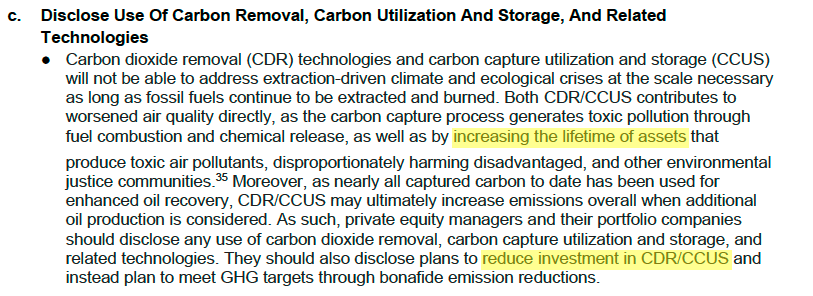
The biggest tell in the whole report is its outright hostility toward actual technological solutions. If this coalition actually wanted to reduce atmospheric carbon, they’d be cheering for Carbon Capture Utilization and Storage (CCUS) – a proven technology backed by serious climate scientists.
Instead, the scorecard actually penalizes firms for investing in it. Why? The methodology says the quiet part out loud: capturing carbon is bad because it “increases the lifetime of [energy-related] assets.” They are openly admitting that lowering emissions doesn’t matter to them if it means traditional energy plants might stay in business a bit longer.
Voodoo Economics
As Pinpoint has previously published, PESP often asserts measures of “risk” that have no correlation to actual outcomes. So it is not a surprise that this report attempts to tie a handful of firms to ‘cost-of-living’, however their methodology relies on pseudoscientific acrobatics.
In its appendices, the authors take a speculative temperature increase of 0.0015 degrees Celsius per year and run it through a blender of unrelated academic studies. From this thousandth-of-a-degree change, they declare that emissions from a handful of firms are mathematically responsible for $0.03996 in annual rent increases per renter, a 0.018% drop in mortgage originations, and exactly 1,400 extra emergency room visits. “Garbage in, garbage out” is an understatement.
Conclusion
This scorecard follows the same playbook that Pinpoint has documented across multiple PESP reports: pick the most inflammatory framing, bury the methodological caveats in the appendices, and engineer the math to fit a predetermined political conclusion.
PESP and AFR are not conducting objective research, but rather laundering a partisan climate change agenda through an academic lens attempting to attack the firms powering the American economy. Media, and decision-makers deserve better than advocacy dressed up as data.
More from Pinpoint:

Subscribe to Pinpoint Policy Institute